
The Strangest Worlds of the Solar System
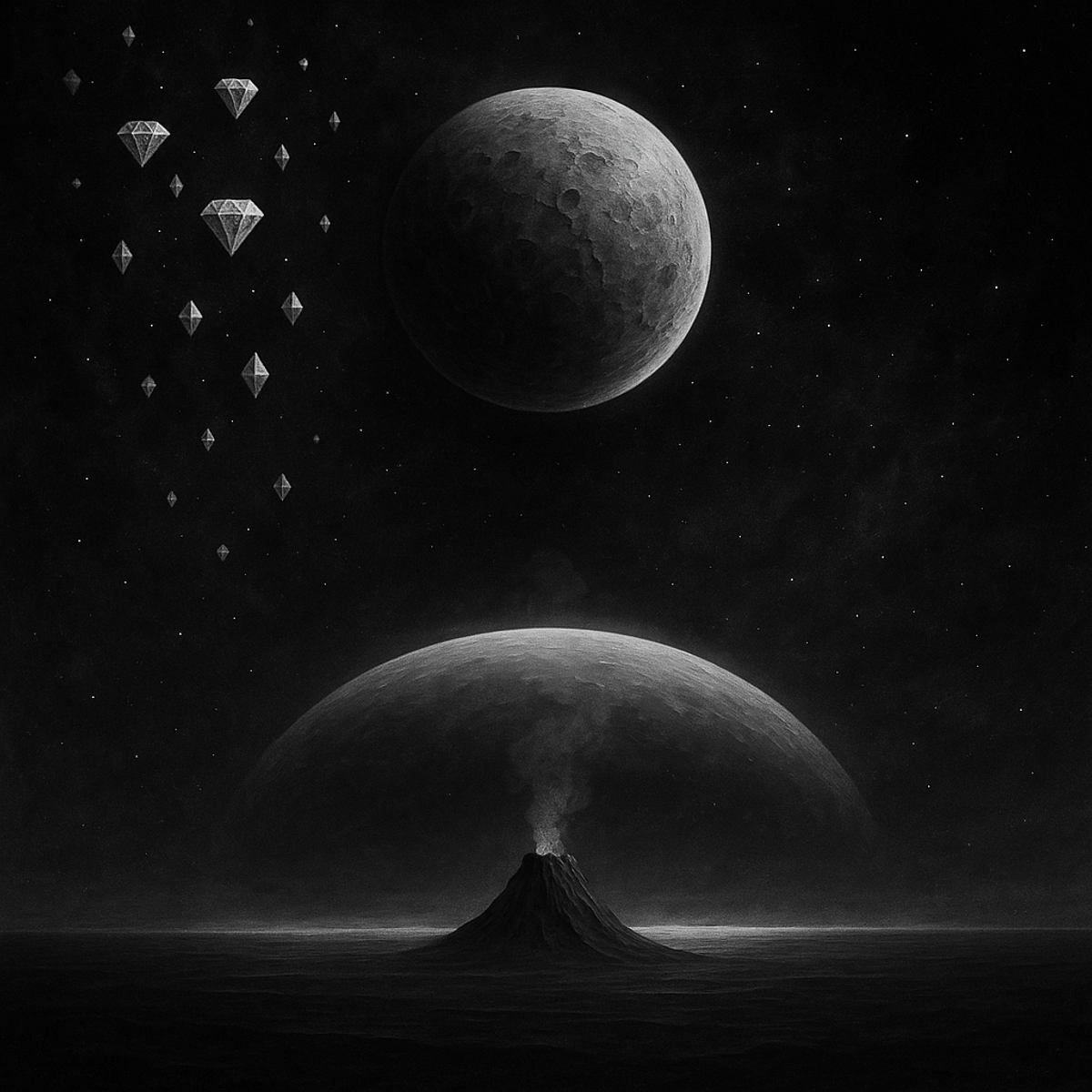
Discover the fascinating phenomena of diamond rains, hidden oceans, and giant volcanoes on the planets and moons of our solar system.
Diamond rains on Neptune and Uranus
One of the most surprising phenomena in our solar system is diamond rain, possible on the icy giants Neptune and Uranus. These gas giants have peculiar chemical compositions. Their atmospheres contain high amounts of methane, which under intense pressure and temperature could break down into pure carbon.
This carbon crystallizes to form diamonds that, according to theories, slowly fall towards the planet's core, creating an exotic 'diamond rain.' This astonishing process, beyond challenging our imagination, reminds us how varied and fascinating our planetary system is.
Hidden oceans beneath the surface
The hidden oceans on moons like Jupiter's Europa and Saturn's Enceladus open new frontiers in the search for extraterrestrial life. Europa is known for its thick ice layer covering a vast salty ocean. This ocean may harbor suitable conditions for life due to the interaction of its rocky core with liquid water.
Enceladus, though small, is equally intriguing. It has geysers that spew water into space, suggesting the presence of a global ocean beneath its icy surface. These discoveries motivate space missions to explore further, hoping to find microbes or new forms of life in these distant oceans.
The mighty volcanoes of Io
Io, Jupiter's volcanically active moon, is a spectacle of colossal proportions. This small world is covered with over 400 volcanoes, some of which are so tall they surpass any earthly mountain. The volcanic activity is due to Jupiter's tremendous gravitational influence, which continuously stretches and heats Io's interior.
The constant swirl of lava flowing across its surface has shaped a surreal and ever-changing landscape. This geological dynamism has implications not only for understanding volcanic activity but also for knowing how these extreme conditions affect its atmosphere and potential to harbor life in the distant past.
The mysterious mantle of Titan
Saturn's moon, Titan, is a world of oddities. With a dense nitrogen-rich atmosphere, it is the only moon with such a thick atmosphere in our solar system. Additionally, it is the only other known place outside Earth with liquid bodies on its surface, albeit in the form of methane and ethane seas and lakes.
Titan holds special interest for scientists due to its organic chemistry. The conditions on its surface and atmosphere are similar to those of early Earth, making it a natural laboratory to study the chemical composition that could have given rise to terrestrial life.
Conclusion: our vast and strange cosmic neighborhood
The phenomena described are not only reminders of the diversity within our solar system but also of how little we know about the complex geological and atmospheric processes elsewhere. Each of these worlds, with their own mysteries and wonders, expands our understanding of the universe.
Robotic exploration and, in the future, perhaps even human exploration of these places could unveil more secrets about their formation and evolution. As we continue observing and exploring, we seek answers not only about other planets and moons but also about the origin and future of our own Earth.

Free Birth Chart
Discover the sky that existed when you were born
We reconstruct the astronomical map of the moment of your birth with exact planetary positions and advanced interpretation.
Get your free chart