
Impact of a Black Hole Near the Solar System
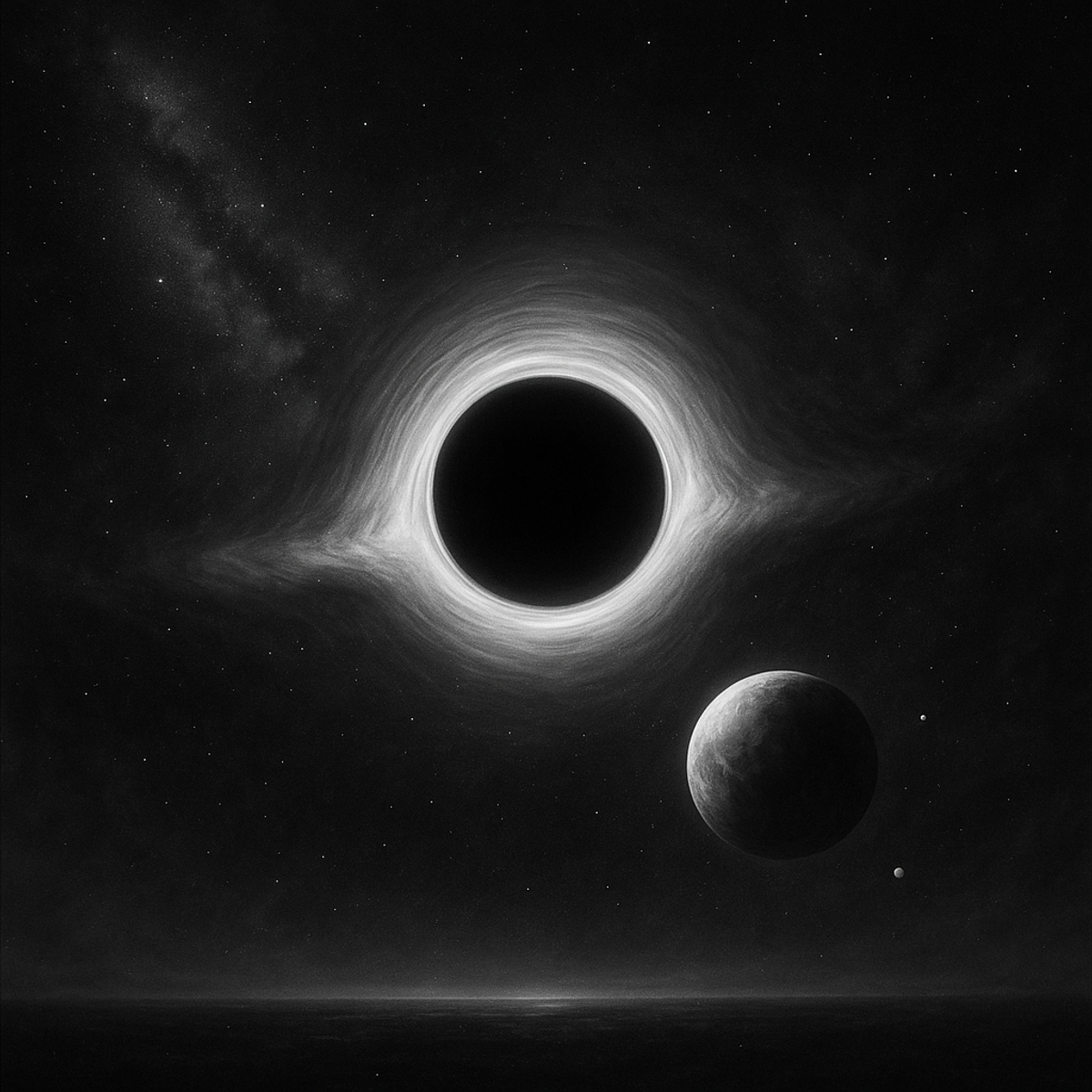
Explore the cosmic consequences of a black hole's proximity to the Solar System. A journey through extreme physics and its effects on Earth.
Introduction to the concept of black holes
Black holes are regions of space where gravity is so intense that nothing, not even light, can escape their influence. These entities arise when a massive star exhausts its nuclear fuel and collapses under its own gravity.
They have become fascinating objects of study due to their extreme properties, capable of warping space-time in unusual ways. However, beyond theory, the possibility of one of these cosmic titans dangerously approaching our Solar System presents a science fiction scenario that, although unlikely, sparks the imagination.
The gravitational effect on the Solar System
If a stellar-sized black hole approached the Solar System, the first and most noticeable effect would be its gravitational disturbance. The gravitational influence of a black hole could alter the orbits of the planets, potentially ejecting them from their current paths.
This change would not be immediate but gradual, allowing astronomers to observe alterations in planetary trajectories. Planets closer to the black hole would be most affected, with their orbits significantly distorted, triggering gravitational chaos in the delicate balance of our planetary system.
Possible effects on Earth
As Earth orbits the Sun, any change in this orbit would be devastating. An approach by the black hole could mean a change in global climate if our path around the Sun is altered, leading to temperature extremes.
Moreover, if our orbital speed is sufficiently affected to push us toward the Sun or out of the Solar System, life as we know it would be in danger. Natural rhythms and the ecosystem would depend on a delicate balance that such a massive celestial body could easily disrupt.
Visual and dreamlike effects: the gravitational lens
Black holes are also known for causing gravitational lensing phenomena. By bending the light of stars beyond them, they create an effect that magnifies and distorts the images of distant objects, like a cosmic mirror.
This phenomenon could offer a spectacular view for astronomers and space enthusiasts from Earth, opening a clearer window to regions of the universe that would otherwise be invisible. However, the beauty of this image would be overshadowed by the danger posed by the proximity of such a massive object.
The science behind black holes and the opportunity for knowledge
Despite the potential threats, a nearby black hole would also represent a unique opportunity for science. The proximity would allow for close study of phenomena such as gravitational waves and relativistic jets.
Better understanding these extreme events would help scientists refine theories about general relativity and galactic dynamics, providing crucial information about the evolution of the universe and the very life of galaxies.

Free Birth Chart
Discover the sky that existed when you were born
We reconstruct the astronomical map of the moment of your birth with exact planetary positions and advanced interpretation.
Get your free chart